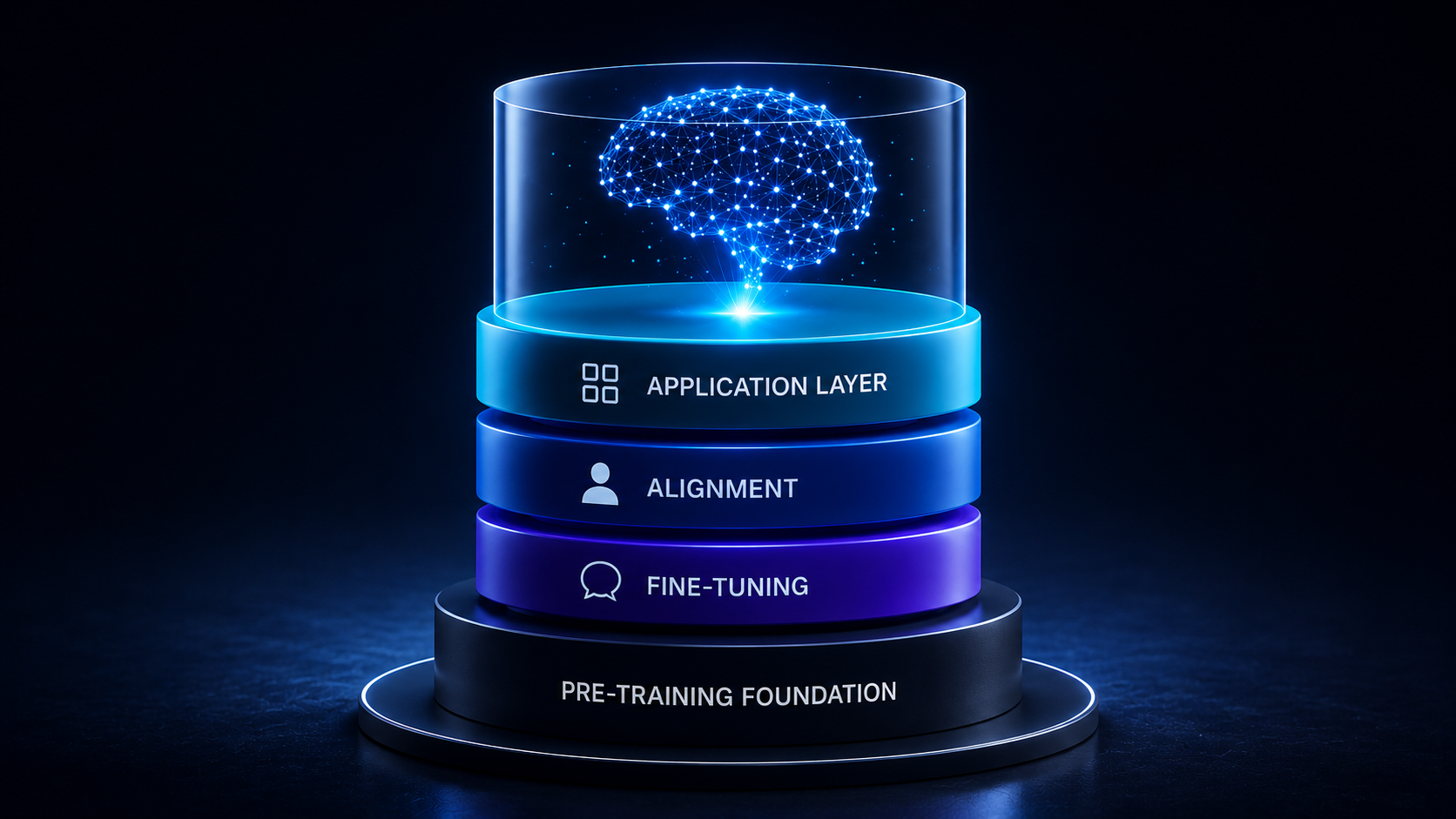
How LLMs Get Smarter After Training And Why That Matters for Your Stack
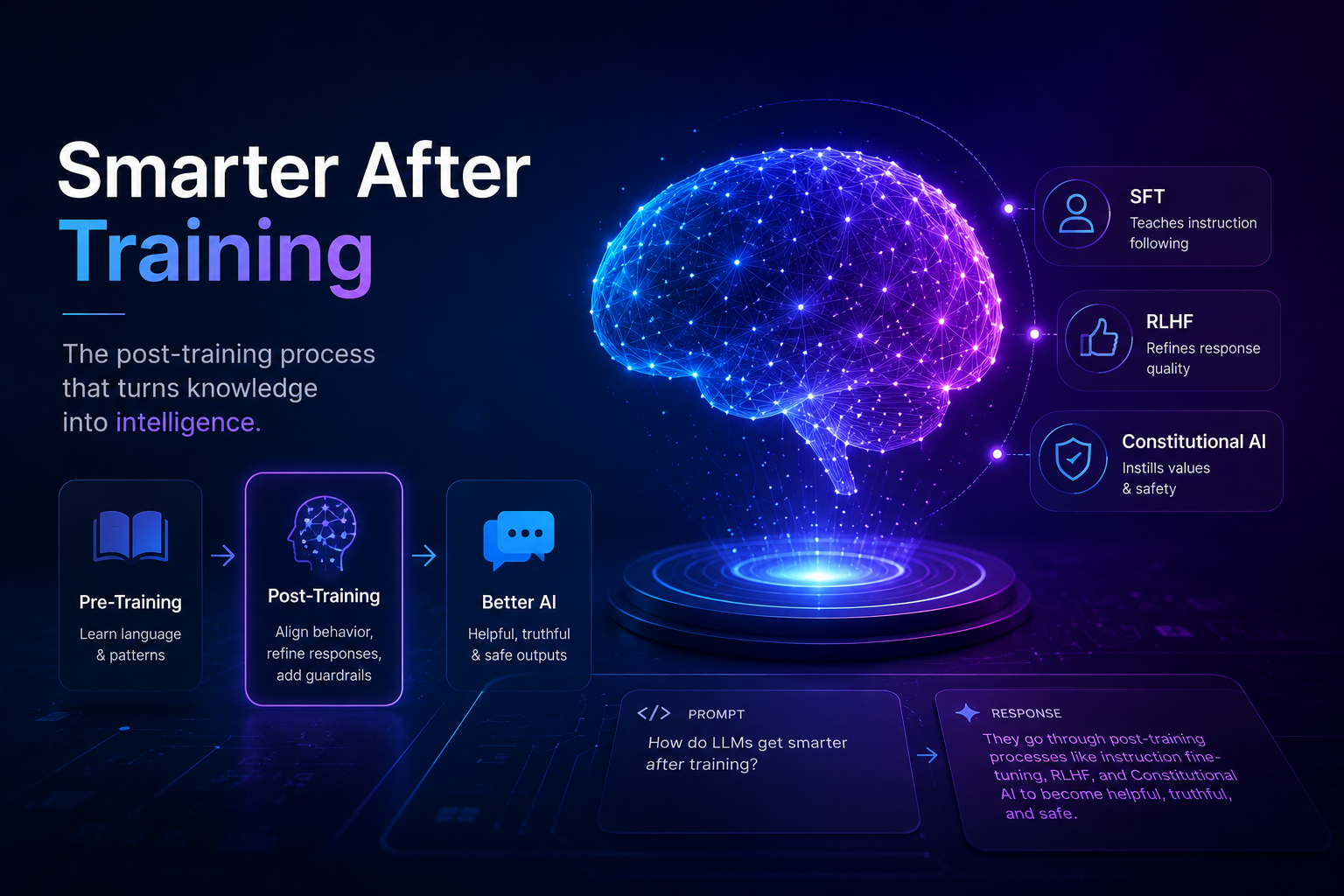
The Gap in Your Mental Model
Most people who work with AI tools daily have a reasonable intuition for what a model can and cannot do. What far fewer have is a clear picture of why it behaves that way specifically, what happens between the moment a model finishes pre-training and the moment it shows up in your product.
That gap matters more than it sounds. It determines how you interpret outputs, how you diagnose problems, and most importantly, how you evaluate whether one AI tool is actually better than another or just better marketed.
In the previous piece, we covered pre-training, the phase where a model absorbs language, facts, and patterns from massive text corpora. That process produces something genuinely powerful, but not something useful. A freshly pre-trained model has no understanding of intent, no preference for accuracy over fluency, and no concept of what you are trying to accomplish when you type a prompt.
Post-training is what closes that gap. And understanding it changes how you think about every AI tool in your stack.
Who this is for
Growth leads, CMOs, and founders who use AI tools operationally and want to understand what actually separates a well-trained model from a poorly trained one beyond the marketing copy.
What Post-Training Actually Does
After pre-training ends, you have a model that is extraordinarily good at one specific thing: predicting the next token. Ask it to continue a sentence and it will. Ask it to follow instructions helpfully and decline harmful requests, and it has no framework for doing either. The raw pre-training process never presented it with those objectives.
Think of it this way. Pre-training produces someone who has read everything every textbook, every forum thread, every news article ever published. Tremendous breadth. But they have not been taught how to be a good employee. They have not learned when to say "I don't know," how to communicate clearly with non-experts, or where the line is between helpful and harmful. That is what post-training does.
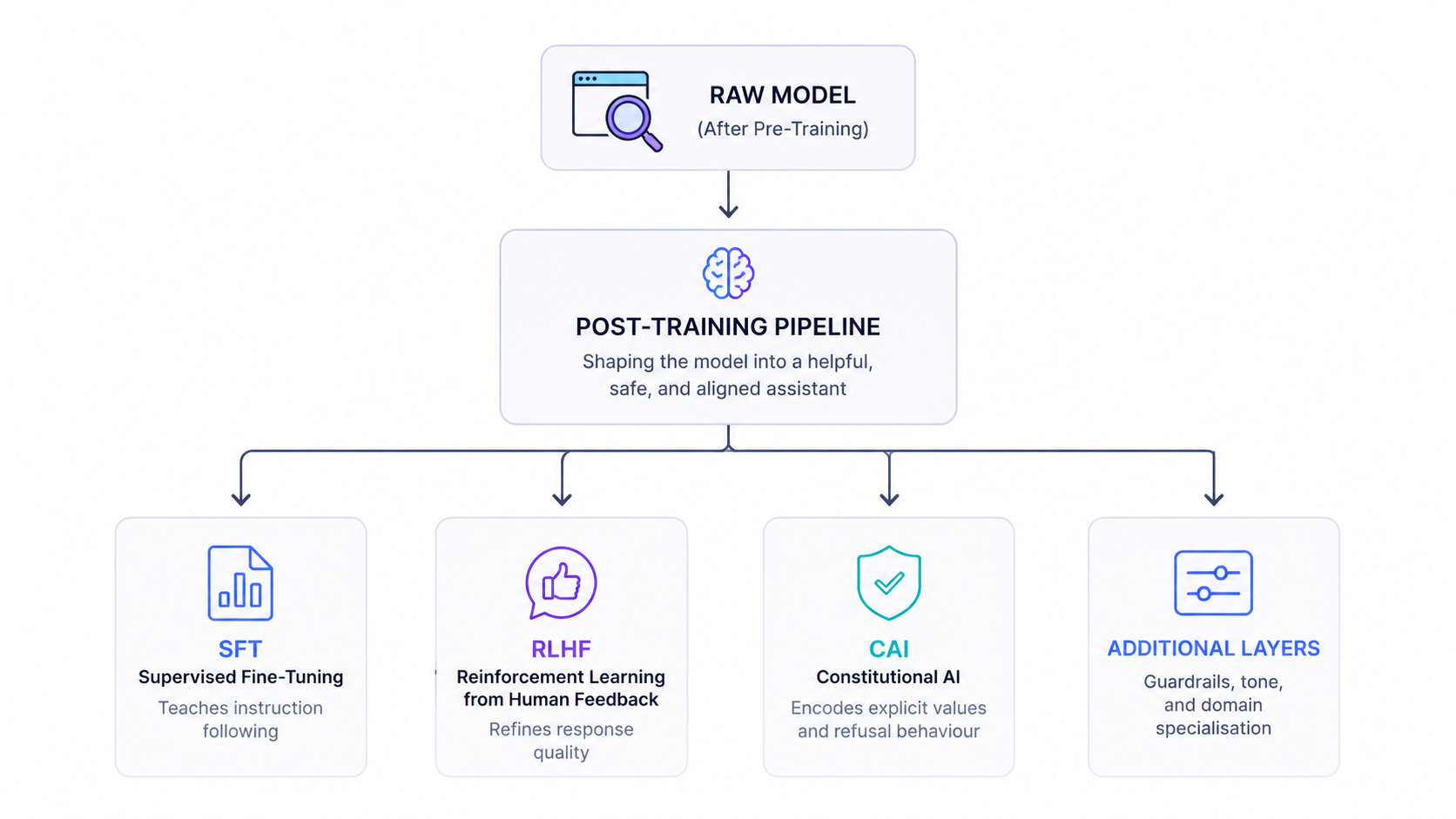
Post-training is a family of techniques applied in sequence. The most foundational is instruction fine-tuning, often called supervised fine-tuning (SFT). It is where the model's behavior gets shaped from a token predictor into something that resembles an assistant. Everything else the guardrails, the tone, the domain specialisation layers on top of this.
Fine-Tuning: The Hidden Differentiator Between AI Products
Instruction fine-tuning works by training the model on a curated dataset of prompt-response pairs examples of the way a good assistant should handle questions, requests, edge cases, and sensitive topics. The training algorithm is similar to pre-training, but the dataset is orders of magnitude smaller and dramatically more deliberate.
This is where the quality of an AI product diverges most sharply from its competitors, and it is almost entirely invisible from the outside. Two products built on the same underlying base model can behave completely differently depending on the quality of their fine-tuning data.
The Dataset Question Your Vendors Won't Volunteer
Building a good fine-tuning dataset is not a technical problem. It is a judgment problem. The people creating the training data typically contracted labelers and subject matter experts have to make thousands of decisions about what "good" looks like.
OpenAI's approach, which became the template for much of the industry, was to give labelers explicit criteria rather than relying on intuition. Three axes: helpful (does this actually answer the question usefully?), truthful (is the information accurate and grounded?), and harmless (does this avoid enabling harm?). Easy to state. Hard to apply consistently across tens of thousands of examples, which is why the investment here varies enormously across vendors.
What to ask vendors
When evaluating AI tools, ask directly: how was the fine-tuning data collected, and by whom? Who reviewed it for quality? How often is it refreshed? These are answerable questions. Vendors who deflect or speak only in vague terms about "human feedback" are telling you something about how much they have invested in this layer.
When a Model Becomes a Product
Once fine-tuning is complete, the model's behavior shifts in a way that is qualitatively different from what came before. It is no longer completing text it is responding to intent. It interprets ambiguous questions, adjusts its register based on context, declines requests it has been trained to decline, and produces outputs calibrated to be useful rather than merely plausible.
One useful mental model: the fine-tuned model becomes a scaled-up simulation of the people who built its training data. When it answers a question, it is pattern-matching not just against language in general, but against the specific decisions of the labelers who taught it what good responses look like. The quality of those labelers, the diversity of their perspectives, and the rigour of their criteria all of this lives permanently in the model's behavior.
"You are not just buying access to a model. You are buying access to the accumulated judgment of every person who shaped its fine-tuning data. That is worth thinking carefully about."
Hallucinations Are a Business Risk, Not a Technical Curiosity
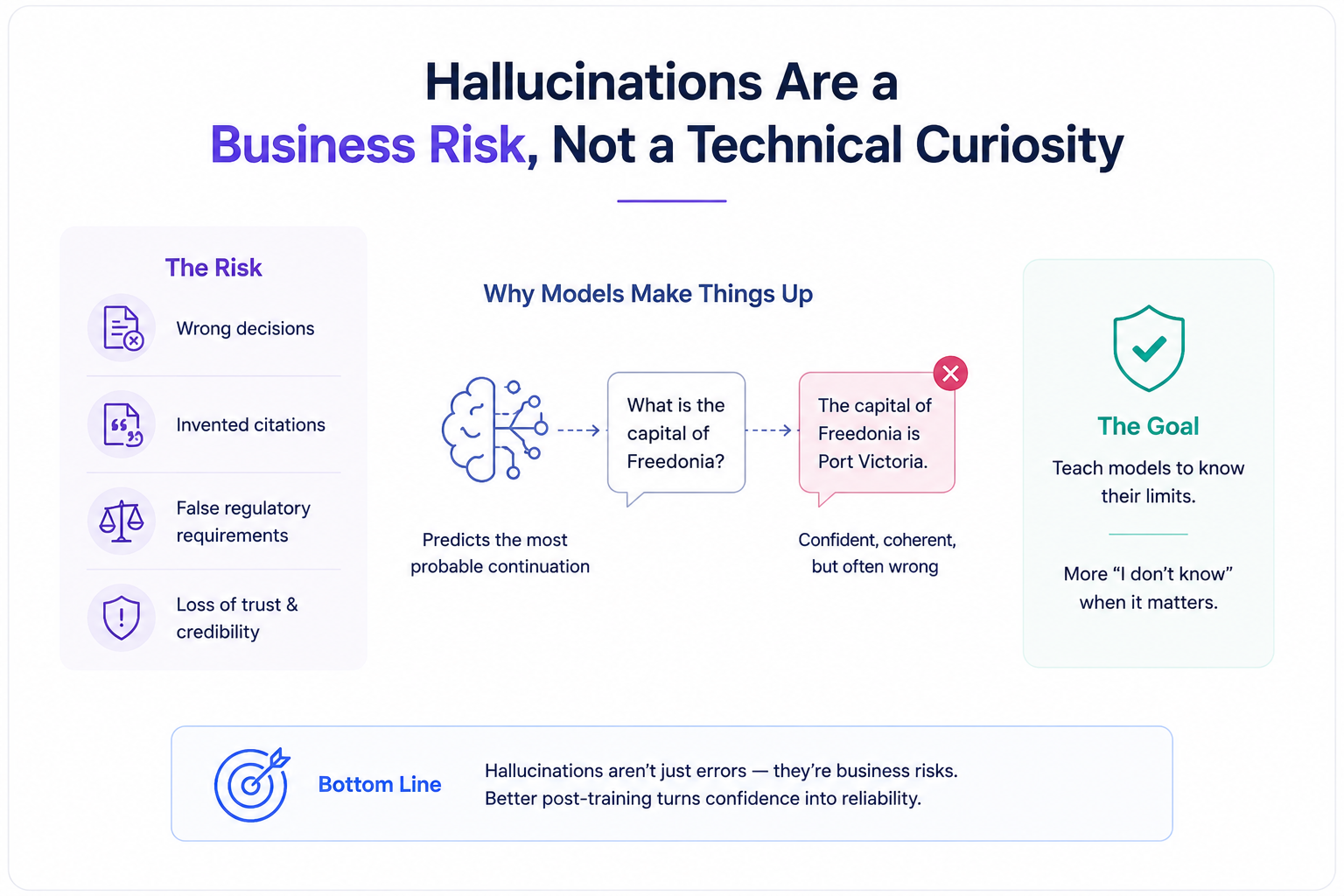
No discussion of post-training is complete without addressing hallucination the tendency of language models to generate confident, coherent, and entirely false information. For most teams, hallucination feels like an occasional annoyance. The more accurate framing is that it is a structural risk that needs to be managed explicitly, not hoped away.
The business cost varies enormously by use case. A model that hallucinates a competitor's feature set in a sales brief, invents a citation in a research summary, or confabulates a regulatory requirement in a compliance document is not just wrong it is actively damaging. The problem is compounded by the fact that hallucinated outputs are often indistinguishable in tone and structure from accurate ones. Confident fluency is not a signal of accuracy.
Why Models Make Things Up
The root cause is architectural. A language model does not have beliefs or verified knowledge. It has a very sophisticated sense of what text typically follows other text. When it encounters a question about something absent or thin in its training data, it does not have a reliable mechanism for detecting that absence. Instead it generates the most statistically plausible continuation which is often a confident-sounding answer that happens to be wrong.
Consider the asymmetry: during training, the model saw thousands of examples of questions answered confidently and correctly. It saw far fewer examples of someone saying "I don't have reliable information on that." The result is a model with a strong prior toward confident response, regardless of whether the confidence is warranted.
A test worth running
Ask any AI tool a specific question about a niche topic, a person outside mainstream coverage, or a very recent event outside its training window. Note whether it says "I don't know" or generates a plausible-sounding but unverifiable answer. The proportion of honest uncertainty responses is a reasonable proxy for post-training quality on this dimension.
How Meta Tackled It with Llama 3
One of the more instructive approaches to reducing hallucination comes from Meta's work on Llama 3, documented in their published research. The technique is straightforward in concept, though expensive to execute at scale.
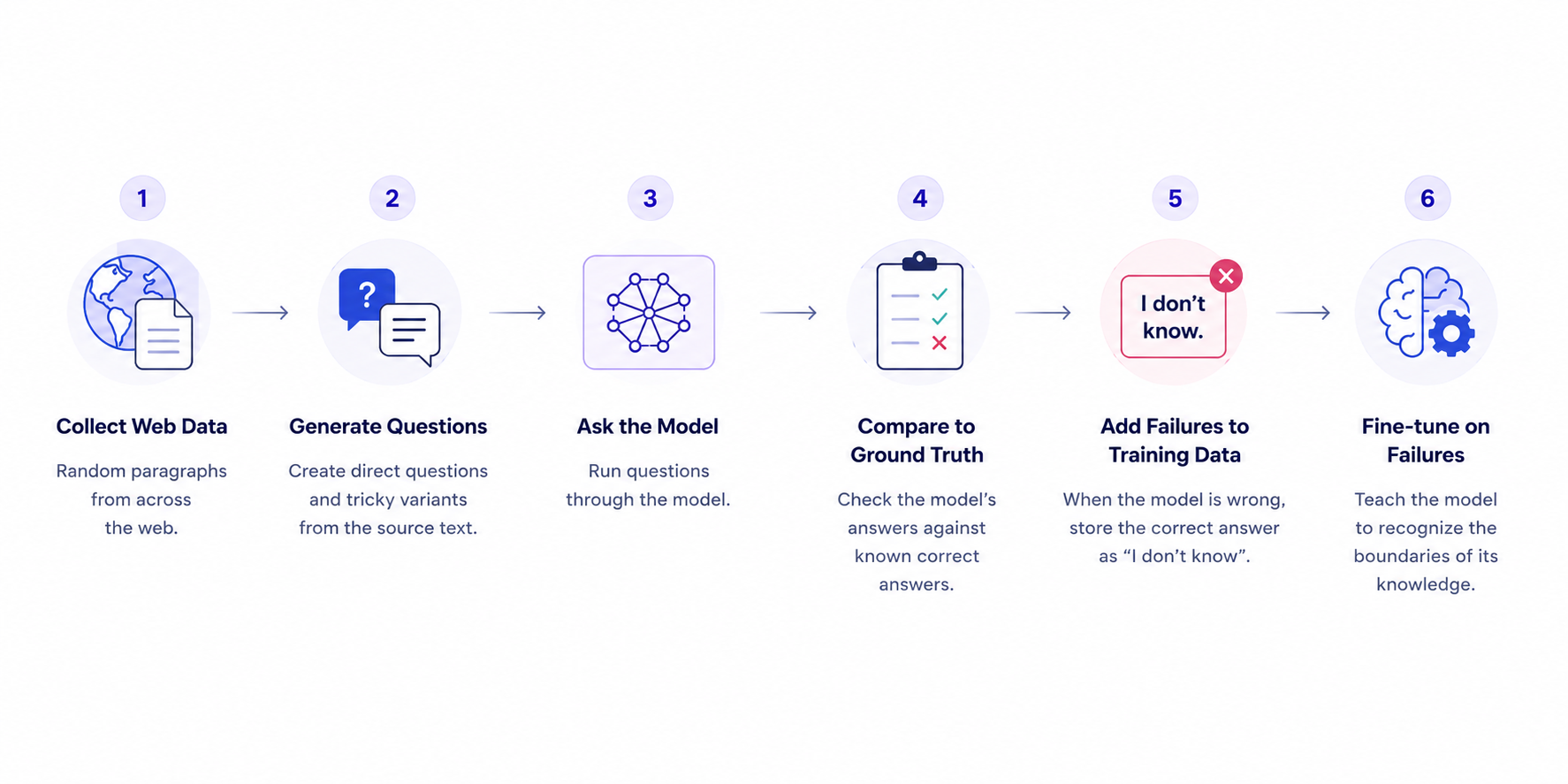
They started with random paragraphs pulled from across the web. From each paragraph, they generated questions both direct questions and deliberately tricky variants where the source text had been altered. They then ran these questions through the model and compared its answers against known ground truth.
Here is where it gets interesting: when the model answered incorrectly, rather than discarding that example, they added it to a new training dataset where the correct answer was simply "I don't know the answer to this question." The model was then fine-tuned on this dataset of its own prior failures.
The result was a model that learned to recognise the boundary of its own knowledge not perfectly, but meaningfully better than its baseline. "I don't know" became a trained behaviour rather than an absent one.
What this signals for vendor evaluation
A model that says "I don't know" when it should is not a weaker model it is a better-trained one. If an AI tool you're evaluating never expresses uncertainty, that is a red flag, not a selling point. Calibrated uncertainty is a sign of serious investment in post-training quality.
What This Means for Your Stack
-
01
Treat hallucination as a workflow design problem
No model is hallucination-free. The question is not whether your AI tools will generate inaccurate information they will but whether your workflows catch it before it causes damage. For high-stakes outputs (customer-facing copy, legal summaries, financial analysis), build explicit human review steps. For low-stakes tasks, accept a higher error rate. Design deliberately rather than assuming model confidence implies accuracy.
-
02
Evaluate fine-tuning quality, not just benchmark scores
Published benchmarks measure specific capabilities on specific tasks. They tell you very little about how a model handles the ambiguous, borderline, and domain-specific inputs that dominate real usage. Build your own evaluation set from your actual workload ten to twenty representative prompts that reflect what your team uses AI for and run every candidate tool through it before committing budget.
-
03
The best models are not always the biggest models
Post-training quality has a larger effect on day-to-day utility than raw model scale for most business tasks. A smaller model with excellent fine-tuning often outperforms a larger model with poor fine-tuning on instruction following, tone consistency, appropriate uncertainty expression, and domain relevance. Don't conflate parameter count or headline benchmarks with fitness for your specific use case.
-
04
Domain fine-tuning compounds faster than you expect
If your team produces consistent AI outputs in a specific domain your industry vertical, your product category, your audience you are already generating data that could fine-tune a model on your specific context. The teams building proprietary fine-tuning datasets today are building a durable advantage that becomes harder to replicate over time. It is worth starting earlier than feels necessary.
What's Coming in Part 3
Post-training is not the end of the story. The next phase in how modern LLMs get deployed and the one with the most immediate implications for operational AI use involves teaching models to interact with the world beyond their training data.
In Part 3, we will cover tool calling: how LLMs are now being trained to invoke external APIs, retrieve live data, execute code, and take actions in real systems rather than just generating text. We will also dig into reinforcement learning from human feedback (RLHF) the mechanism behind the alignment improvements in every frontier model and look at what DeepSeek R1's architecture reveals about the next generation of reasoning models.
Each of these has a direct operational implication for how you build AI workflows, evaluate vendors, and think about where AI fits versus where humans need to stay in the loop. The goal, as always, is not to understand these systems for their own sake it is to make better decisions with them.
Stay sharp
Get insights like this in your inbox
Strategic briefings on AI, growth, and the tools reshaping modern marketing no filler, straight to the point.