What Pre-Training Really Means for the AI Tools Running Your Growth Stack
The Knowledge Gap Costing You
Most growth teams have a functional relationship with AI tools they use them, they are impressed by them, and occasionally they are frustrated by them. What relatively few have is a working model of why those tools behave the way they do.
That gap is expensive. It leads to poorly structured prompts, misplaced trust in AI-generated outputs, and poor vendor evaluation decisions. Teams optimise for the wrong variables when they hit limitations, and they rarely know what they are actually buying when they purchase an AI product.
Understanding the pre-training phase, the foundational learning process that shapes every large language model closes a large part of that gap. This is not a computer science explainer. It is a strategic briefing for practitioners who make decisions that depend on AI infrastructure every day.
Who this is for
Growth leads, CMOs, and founders deploying AI tools across their marketing and analytics stack. No machine learning background required but the implications are directly operational.
Pre-Training: A Precise Definition
A large language model does not begin its life knowing how to write a brief, summarise a report, or analyse campaign performance. It begins as a blank neural network billions of weighted connections with no initial direction or knowledge.
Pre-training is the phase where that network develops its understanding of language, context, and world knowledge. Not through instruction or human feedback, but through pattern recognition at enormous scale. The model reads text, predicts what word or token comes next, compares its prediction to reality, and adjusts its internal weights accordingly. This loop runs trillions of times across hundreds of billions of tokens.
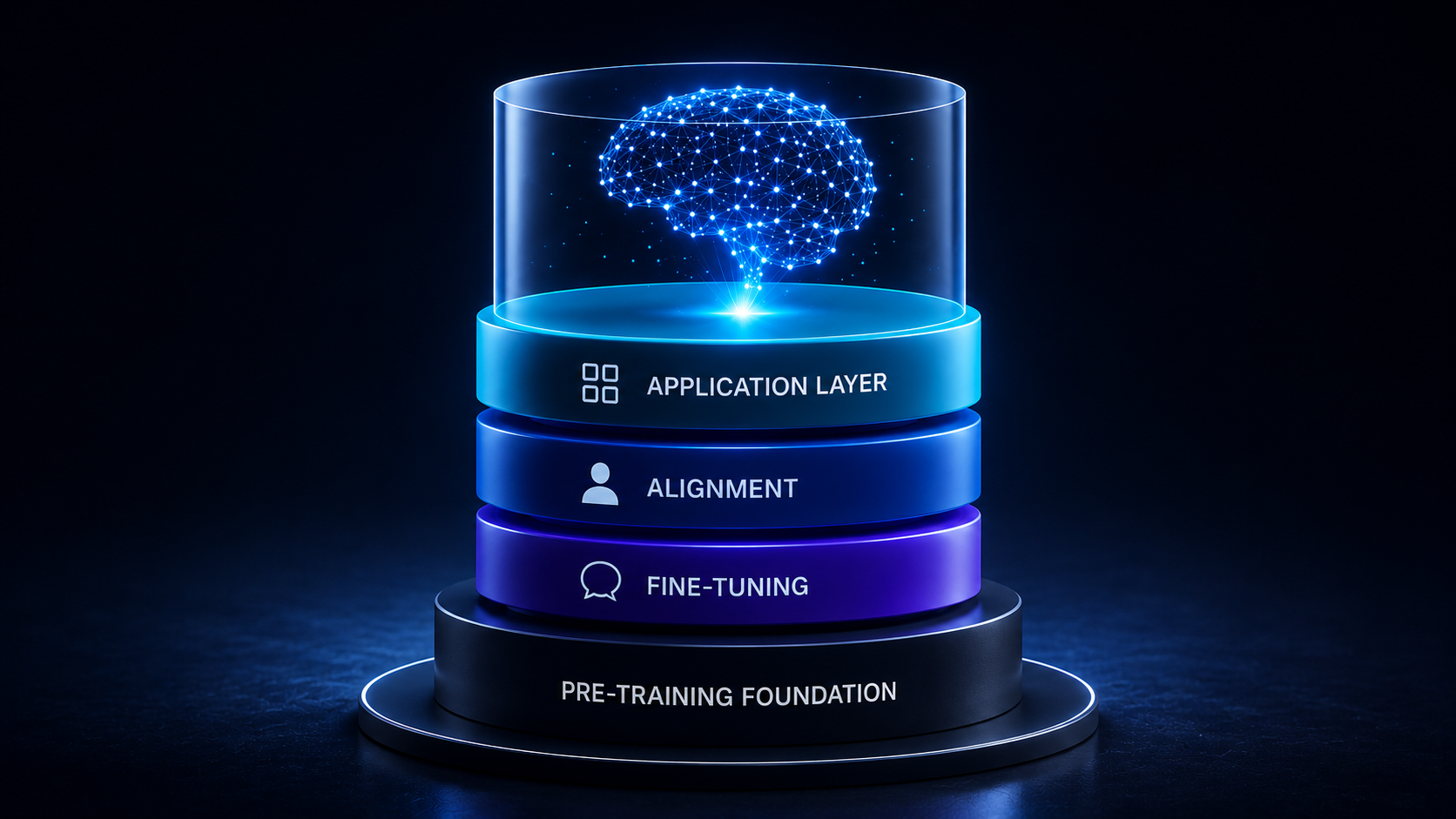
Every relationship the model will ever draw on between words, industries, concepts, geographies, and ideas is absorbed here. Everything that follows (fine-tuning, alignment, the product-layer features you interact with daily) operates on top of this foundation. You cannot instruct your way out of a weak pre-training base.
"The quality of a model's outputs is bounded by the quality of what it was trained on. Post-training processes can refine the surface they cannot deepen the foundation."
Your AI's Knowledge Has a Quality Floor
The single most consequential variable in pre-training is the training corpus the dataset the model learns from. The scale is difficult to internalise. Common Crawl, the most widely used web corpus, contains snapshots from over 250 billion web pages collected across 18 years of internet history. The largest frontier models are trained on datasets measured in trillions of tokens.
But scale is not the same as quality. Raw web data is predominantly noise: spam, duplicate content, low-quality forum posts, machine-generated text, and broken markup in dozens of languages at varying quality levels. Every major AI lab runs extensive preprocessing pipelines deduplication, quality filtering, content classification, toxicity removal to refine the raw corpus before it reaches the model.
The Noise Problem
What survives these filters shapes what the model believes to be authoritative. A corpus with disproportionate representation from certain industries, geographies, or time periods will reflect those biases in every output it generates. This is not a failure of the model it is an accurate reflection of what it was shown. A model trained heavily on English-language B2C marketing content will write better B2C marketing copy than B2B financial analysis, not because of capability differences, but because of corpus composition.
For growth teams, this has a direct implication: AI tools perform better in domains that are well-represented in the training data. If your industry, product category, or customer segment is niche, underrepresented, or uses highly specialised terminology, you will consistently encounter a performance ceiling that no amount of prompt tweaking can fully overcome only fine-tuning on domain-specific data can.
The Cutoff Problem
Pre-training ends. The model's knowledge is frozen at that point. Any market development, regulatory shift, platform update, competitor move, or product launch that occurred after the training cutoff is simply absent from the model's world. It does not know what it does not know it will often generate plausible-sounding but outdated information with the same confidence it applies to well-established facts.
Operational implication
For any query involving recent market conditions, emerging competitor behaviour, platform algorithm changes, or new regulatory requirements treat AI output as a starting hypothesis requiring external validation, not a finished answer. Build your workflows and QA processes accordingly.
Tokenization and the Prompt Problem
Before any text enters a language model, it must be converted into tokens, discrete numerical units the model can process. This conversion process, called tokenization, has practical consequences that most practitioners never account for.
Tokens are not words. They are subword units derived from statistical patterns in the training data. Common English words are typically single tokens. Uncommon words including brand names, technical jargon, newly coined terms, and domain-specific terminology are frequently split across multiple tokens or represented in ways that fragment their semantic coherence. GPT-4o operates on a vocabulary of over 100,000 possible tokens.
The practical consequence for growth teams: the model processes your prompt token by token, and it has stronger, denser representations for high-frequency vocabulary than for specialist or brand-specific language. This is one structural reason why precise, plain-language prompting consistently outperforms jargon-heavy or highly technical inputs the model's internal representations for common language are simply more robust.
What this means for your prompts
When writing prompts that include industry-specific terminology, product names, or technical concepts, define them explicitly within the prompt. Do not assume the model has the same internal representation of your vocabulary that your team does. The closer your prompt language is to the model's training distribution, the better the output.
Base Models Are Not Products
After pre-training concludes, the result is a base model a system that has internalised the statistical patterns of its training corpus and can generate fluent, contextually plausible text. What it cannot reliably do is follow instructions, maintain a persona, answer questions helpfully, or refuse harmful outputs.
A base model is, fundamentally, a sophisticated token completion engine. Present it with the opening of a Wikipedia article and it will continue that article. Present it with an unfinished sentence and it will complete it probabilistically. It has absorbed the structure of language and a broad representation of human knowledge without any of the intent, values, or task orientation that make a model useful in a commercial context.
Every AI product you currently pay for is a base model that has been subsequently reshaped. Post-training processes instruction fine-tuning, reinforcement learning from human feedback (RLHF), domain-specific adaptation transform the base model into a deployable product. The quality of the base model sets an absolute ceiling on what those post-training processes can achieve.
This matters directly for vendor evaluation. Two products built on different base models are not interchangeable, regardless of how similar their interfaces appear. Two products built on the same base model may diverge dramatically depending on the quality of their post-training work. When evaluating AI tools, understanding which base model underlies the product and the quality of the post-training layer on top of it is a more meaningful assessment criterion than any feature comparison or demo.
In-Context Learning: The Lever You Control
There is one capability that emerges directly from pre-training that growth teams can leverage without any access to the model's weights or training process: in-context learning.
A pre-trained model can infer patterns from examples and information provided within its active context window. Provide structured examples of an input-output format, and it will apply that pattern to new inputs. Provide background on your company, audience, or product, and it will incorporate that information into its outputs without any retraining or fine-tuning.
This is not a minor capability. It is the primary mechanism through which every well-structured prompt operates. The model treats your context window as temporary working memory a space where you establish conventions, supply reference material, set constraints, and demonstrate the format and register you require. The precision and completeness of that working memory directly determines output quality.
"The context window is not a search bar. It is a workspace. Teams that treat it accordingly loading it with structured, high-quality context rather than terse queries get categorically different results."
The strategic implication is significant: prompt engineering is not a workaround for an underpowered tool. It is the primary interface through which you interact with a system whose capabilities were determined before your organisation's name was ever mentioned. Teams that understand this design fundamentally different workflows and extract fundamentally different value from the same tools their competitors are also using.
What This Means for Your Growth Stack
-
01
Evaluate vendors on training data, not demos
Two products with comparable interfaces may be built on corpora with very different quality and recency profiles. Ask vendors directly: What corpus underlies the base model? What is the training cutoff? Has the base model been updated, or only the product layer? These are answerable questions vendors who cannot answer them are telling you something.
-
02
Build context documents as infrastructure
The teams extracting the most consistent value from AI tools have invested in high-quality context documents detailed product briefs, audience personas, brand voice guidelines, competitive frameworks that are injected into prompts systematically. This is not a technical project. It is a knowledge organisation project, and it compounds over time.
-
03
Design workflows around the cutoff constraint
For any task involving recent market conditions, competitor behaviour, or emerging trends, treat AI output as a starting point that requires external validation not a finished answer. The most robust AI-augmented workflows explicitly separate what the model knows from what needs to be verified against current sources.
-
04
Identify where fine-tuning is genuinely warranted
If your domain is consistently underrepresented in public training data specialist B2B verticals, highly regulated industries, non-English primary markets consider whether fine-tuning on proprietary data is more cost-effective than continuing to engineer around a base model that was not trained on your domain. The economics often favour fine-tuning sooner than teams expect.
The Road Ahead
The pre-training phase is the first chapter in a longer lifecycle that determines how an AI model behaves in production. Post-training processes instruction fine-tuning, reinforcement learning from human feedback, constitutional AI methods shape the base model into a deployable product. The emergence of reasoning models, multi-modal architectures, and retrieval-augmented generation systems are all built on this same foundation.
The next evolution in this space and the one with the most immediate implications for growth operations is the shift from static pre-training corpora to continuously updated models, and the maturation of retrieval augmentation as a standard architecture layer. Both developments directly address the cutoff and recency constraints outlined above.
Understanding the foundation does not require a background in machine learning. It requires the same structured thinking you would apply to understanding any other critical infrastructure your growth operations depend on. The teams that develop this understanding now will be substantially better positioned to evaluate new tools, design more effective workflows, and extract disproportionate value from a landscape that is only becoming more competitive.
In a subsequent piece, we will examine what happens after pre-training the post-training phase, how instruction tuning and RLHF transform a base model into a product, and what this means for the specific AI tools running your stack today.
Stay sharp
Get insights like this in your inbox
Strategic briefings on AI, growth, and the tools reshaping modern marketing no filler, straight to the point.

SEO Strategy
10 SEO Trends That Will Dominate 2026: Stay Ahead of the Curve

Analytics
Data-Driven Decision Making: How to Use Analytics to Grow Your Business