Google Tag Manager's Biggest Update in Years: GTM Is Becoming a Google Tag
Google Just Changed the Future of Digital Analytics
Google Tag Manager is entering a completely new era.
At Google Marketing Live 2026, Google announced one of the most important GTM transformations since the platform was launched. This is not simply a user interface redesign or a workflow enhancement.
Google is fundamentally changing the architecture of GTM itself.
The headline update is massive:
"Your GTM container can now become a Google Tag."
That single change represents a broader industry shift toward:
- centralized measurement infrastructure
- first-party data collection
- privacy-first analytics
- server-side architecture
- scalable event governance
- unified cross-platform tracking
For years, GTM functioned primarily as a deployment layer for marketing scripts.
Now it is evolving into something much larger: a centralized data routing and measurement system designed for the future of the web.
Why Google Is Rebuilding GTM
The internet has changed dramatically over the past few years.
Modern browsers increasingly restrict:
- third-party cookies
- cross-site tracking
- long-term attribution
- browser-side data persistence
- external script execution
At the same time:
- Privacy regulations continue expanding
- Ad blockers are becoming more aggressive
- Businesses need accurate attribution
- Websites need faster performance
- Marketers expect cleaner data
Traditional client-side tagging systems are struggling in this environment.
Older GTM implementations often became:
- bloated
- fragmented
- inconsistent
- difficult to maintain
- performance-heavy
Google's answer is a complete infrastructure-first redesign of measurement architecture.
GTM Is Becoming a Google Tag
Historically, most websites followed this structure:
Legacy GTM Architecture
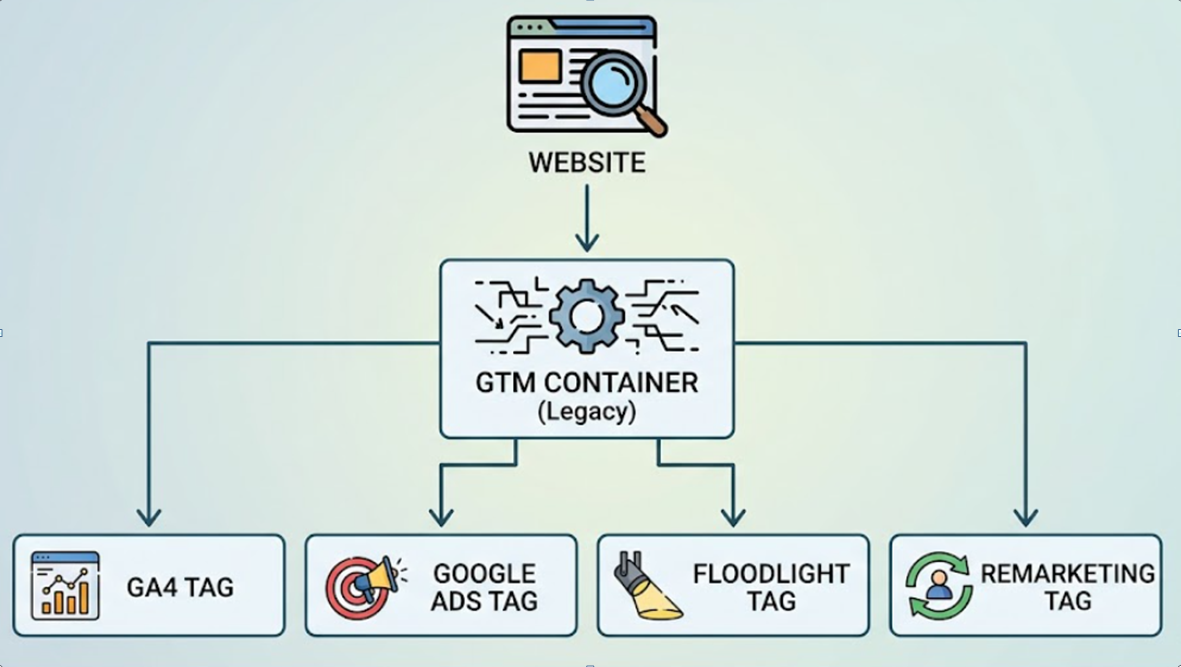
Each platform required separate implementation logic, separate configurations, and often separate versions of tracking libraries.
This created:
- duplicated logic
- inconsistent event handling
- fragmented attribution
- reporting discrepancies
- unnecessary browser load
Now Google is introducing a much cleaner model:
Modern GTM Infrastructure
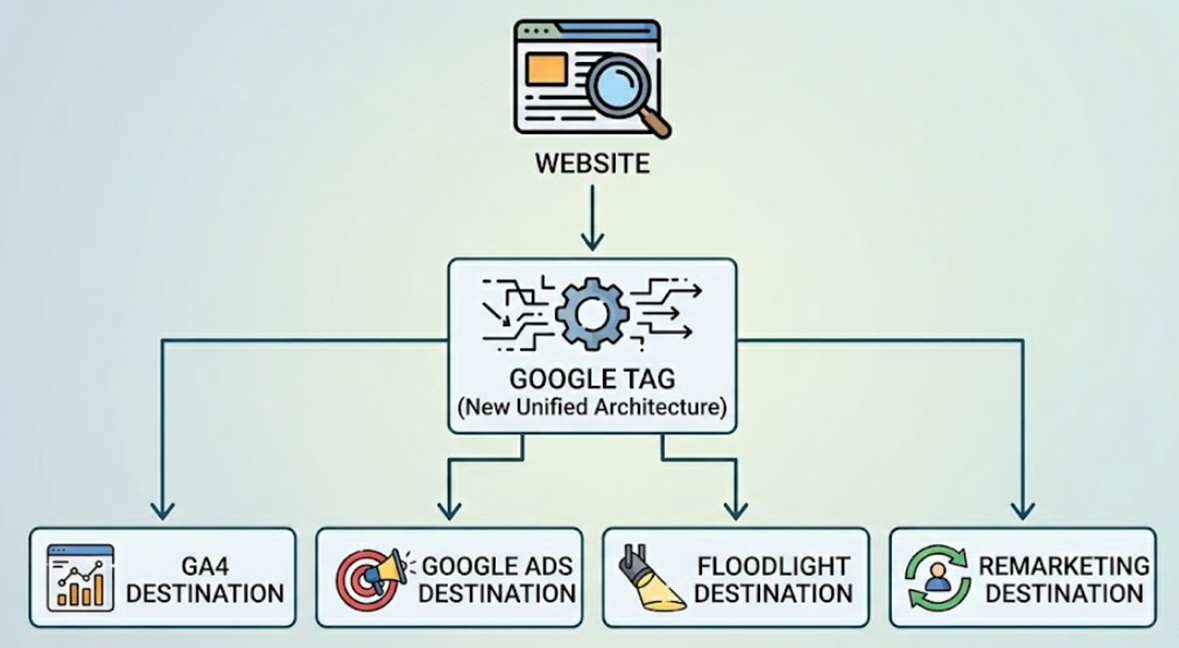
Instead of firing isolated tags independently, GTM becomes a centralized measurement layer capable of distributing event data across multiple Google products simultaneously.
This is one of the most important architectural changes in GTM's history.
This Upgrade Is Currently Optional
One important detail businesses should understand:
The new GTM-to-Google-Tag architecture is currently an opt-in upgrade.
Organizations are not being forced into an immediate migration.
This is important because:
- Existing containers will continue functioning
- Businesses can upgrade gradually
- Enterprise implementations can be tested safely
- Teams can validate compatibility before rollout
For large organizations managing complex tracking ecosystems, gradual migration is critical for reducing operational risk.
This also gives analytics teams time to modernize infrastructure strategically instead of reacting under pressure.
What Are Destinations in GTM?
One of the biggest new concepts introduced in GTM is Destinations.
Older Google Tags now become "Destinations" managed centrally through GTM.
Instead of maintaining:
- separate GA4 tags
- separate Ads tags
- separate remarketing configurations
GTM can now route standardized events across multiple platforms through one centralized Google Tag.
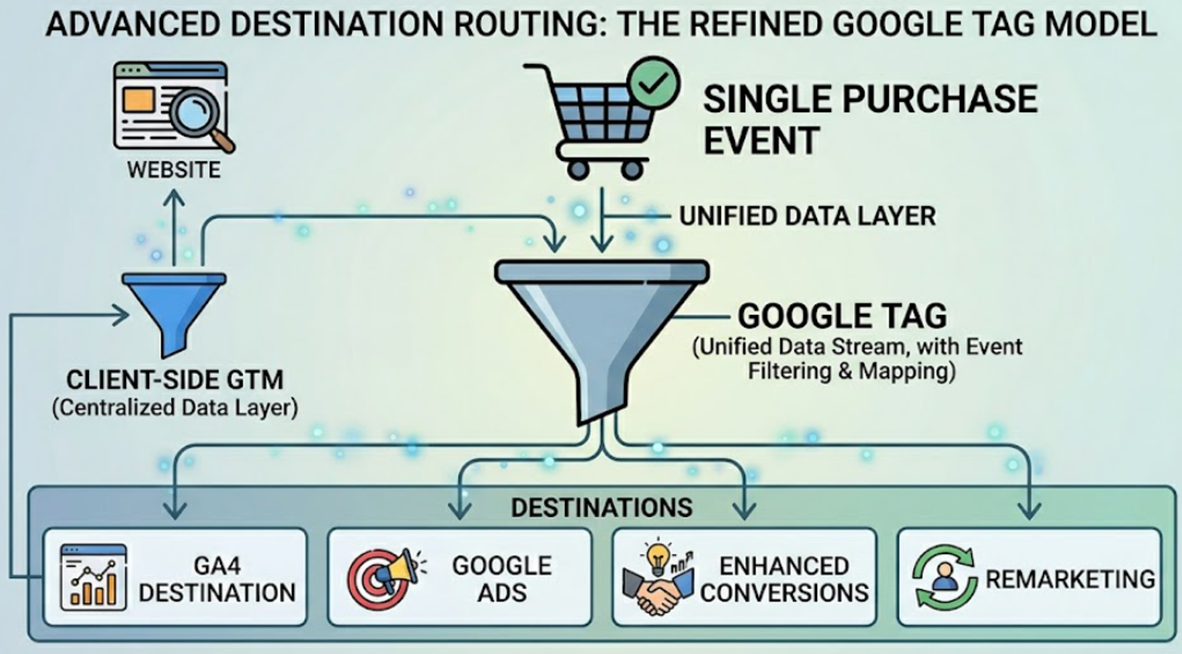
This creates:
- cleaner implementations
- consistent event structures
- easier debugging
- centralized governance
- better scalability
The mindset shifts from:
"Which tag should fire?"
to:
"How should data flow through the infrastructure?"
That shift changes the entire philosophy of analytics implementation.
Why This Improves Website Performance
One of the most overlooked benefits of the new GTM architecture is performance optimization.
The Old Model
Historically, different Google products often loaded separate instances of:
gtag.js
This created:
- duplicate network requests
- additional JavaScript execution
- unnecessary browser processing
- slower interaction responsiveness
As websites added more marketing platforms, performance overhead increased significantly.
The New Infrastructure Model
With Destinations and centralized Google Tag architecture, multiple Google products can operate through the same GTM-managed infrastructure.
This reduces:
- redundant script loading
- duplicate processing
- browser-side workload
- execution complexity
The result:
- faster websites
- cleaner execution
- lower JavaScript overhead
- better scalability
This directly supports improvements in:
- Interaction to Next Paint (INP)
- Core Web Vitals
- page responsiveness
- technical SEO performance
Analytics infrastructure is now directly connected to SEO performance in ways many businesses still underestimate.
Centralized Settings and Governance
Google is also introducing centralized settings management inside GTM.
Instead of managing configurations separately across multiple tags, teams can now manage:
- consent handling
- shared settings
- event routing
- destination mapping
- governance rules
through centralized infrastructure.
This dramatically reduces:
- implementation inconsistency
- maintenance complexity
- debugging difficulty
- governance fragmentation
For enterprise analytics environments, this is a major operational improvement.
The Visual Event Builder Changes Everything
One of the most exciting GTM updates is the new visual event builder.
Users can now create tracking logic visually by interacting directly with elements on a live website.
This lowers the barrier to entry for:
- marketers
- growth teams
- SEO specialists
- performance advertisers
because many tracking workflows no longer require:
- CSS selector expertise
- complex triggers
- custom JavaScript
- developer-heavy implementation
However, this creates an important industry shift.
Simpler Tracking Becomes Easier
Basic analytics implementation becomes dramatically more accessible.
Advanced Analytics Becomes More Valuable
At the same time, advanced analytics expertise becomes even more important.
Modern measurement systems increasingly require:
- Server-Side GTM
- BigQuery integrations
- consent orchestration
- DataLayer engineering
- event modeling
- infrastructure governance
This means the role of analysts is evolving from "tag deployment" toward "measurement architecture design."
That distinction will define the future of analytics careers.
GTM Is Becoming a Single Source of Truth
One of the biggest hidden benefits of the new architecture is improved data consistency.
Historically:
- GA4 showed one number
- Google Ads showed another
- CRM systems showed something different
These discrepancies happened because separate tags often relied on separate logic and separate firing conditions.
The new centralized event model helps solve this problem.
Instead of: Different tags → Different logic → Different reporting
Businesses can move toward: One event → Multiple destinations → Consistent measurement
This creates:
- cleaner attribution
- stronger trust in reporting
- improved cross-platform consistency
- better business intelligence alignment
For organizations spending heavily on advertising, this is extremely valuable.
Why Server-Side GTM Is Becoming Essential
Behind many of these updates is a larger trend: The rise of server-side measurement infrastructure.
Modern analytics stacks increasingly look like this:
This architecture improves:
- first-party data collection
- attribution durability
- privacy compliance
- data ownership
- tracking reliability
As browser restrictions continue growing, server-side GTM is quickly becoming foundational infrastructure for future-ready analytics systems.
2026 GTM Readiness Checklist
Businesses preparing for the future of analytics should begin focusing on several key areas now.
Audit Duplicate Tags
Check whether GA4 tags, Google Ads tags, and remarketing tags are duplicating logic unnecessarily. Centralized routing will reduce this complexity significantly.
Evaluate Server-Side GTM
If your organization has not started exploring server-side tagging, now is the time. Server-side infrastructure is rapidly becoming essential for attribution durability, privacy compliance, and first-party data strategies.
Master Consent Mode v2
Consent handling is no longer just about compliance. Modern infrastructure must manage consent intelligently across routing, event distribution, attribution systems, and server-side processing. Consent-aware infrastructure will become a major competitive advantage.
Standardize Your DataLayer
The future of GTM depends heavily on clean event architecture. Organizations with poorly structured DataLayers will struggle to scale modern measurement systems effectively.
Business Impact: Old GTM vs Modern GTM Infrastructure
| Area | Traditional GTM | Modern GTM Infrastructure |
|---|---|---|
| Event Logic | Duplicated across multiple tags | Centralized routing |
| Performance | Heavy browser-side execution | Optimized infrastructure |
| SEO Impact | Increased JS overhead | Better Core Web Vitals potential |
| Privacy | Manual consent workflows | Consent-aware infrastructure |
| Attribution | Cookie-dependent | First-party enhanced |
| Governance | Fragmented configurations | Unified management |
| Scalability | Difficult to maintain | Infrastructure-first architecture |
| Data Consistency | Platform discrepancies | Unified event distribution |
The Future of GTM
Google Tag Manager is no longer just a marketing utility.
It is evolving into a centralized measurement infrastructure platform designed for:
- analytics governance
- privacy-first tracking
- event routing
- first-party measurement
- server-side processing
- scalable data architecture
The future of analytics is no longer about firing more tags.
It is about building reliable, scalable, and privacy-compliant measurement systems that continue working in increasingly restrictive digital environments.
Organizations that adapt early to this infrastructure-first approach will gain major advantages in analytics accuracy, SEO performance, advertising optimization, customer intelligence, and long-term measurement durability.
This is not simply a GTM update. It is the future of digital measurement infrastructure.
For more insights on server-side tagging, advanced analytics implementation, GTM architecture, and scalable tracking systems, visit Growth Tuning.
Stay sharp
Get insights like this in your inbox
Weekly breakdowns on analytics, GTM architecture, and measurement strategy — no fluff, straight to the point.

SEO Strategy
10 SEO Trends That Will Dominate 2026

Analytics
Data-Driven Decision Making: How to Use Analytics to Grow Your Business